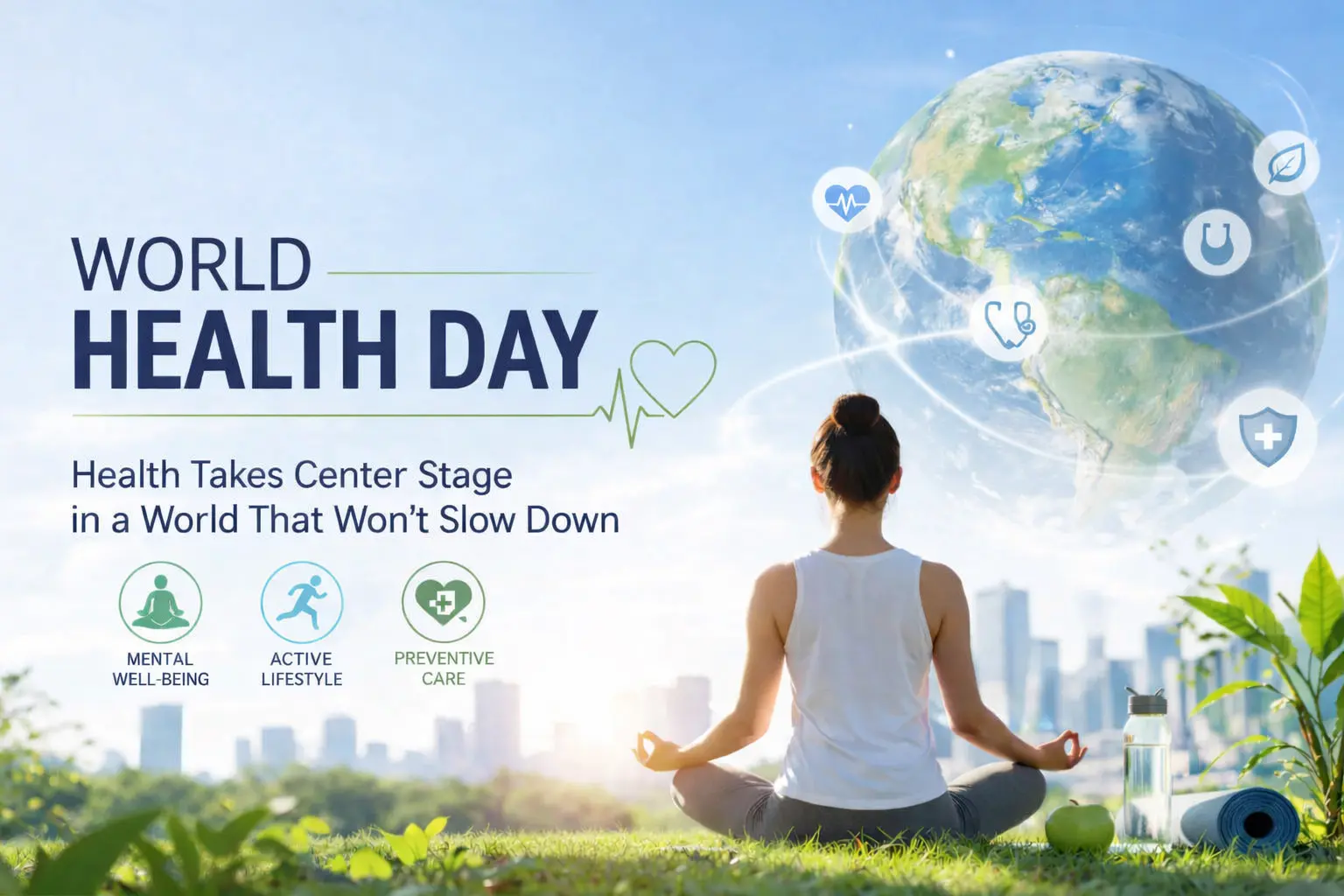
April 7 isn’t just another date on the calendar. World Health Day has always been a reminder — sometimes gentle, sometimes urgent — that health isn’t something we can put off until tomorrow. But in 2026, that reminder feels less like a nudge and more like a siren.
Mental health is fraying at the edges for millions of people. Climate change is no longer a distant threat — it’s showing up in emergency rooms as heatstroke, allergies, and diseases that barely had names a generation ago. And lifestyle conditions that were once associated with old age are now being diagnosed in people in their twenties and thirties. Something has clearly shifted, and this year’s World Health Day asks us to face that honestly.
What Actually Happens on This Day
Around the world, April 7 becomes a hub of activity. Hospitals open their doors for free check-ups. Schools run awareness drives. Governments use the occasion to launch new health schemes or take stock of old ones. Marathons and yoga sessions fill public spaces, and social media lights up under #WorldHealthDay with stories, tips, and calls to action.
It’s one of the few days when health genuinely becomes a public conversation — not just a private worry.
Why 2026 Hits Different
The WHO’s theme this year — “Together for Health, Stand with Science“ — isn’t just a slogan. It’s a direct response to a world where misinformation spreads faster than medicine, and where people are increasingly turning to shortcuts instead of solutions.
Science needs to be trusted again. Evidence needs to guide decisions — in clinics, in kitchens, in classrooms, and in government corridors. That’s what this year is really asking of us.
India’s Wake-Up Call
The numbers coming out of India are hard to ignore. The country already holds the unfortunate title of global capital for diabetes and hypertension. It now ranks second worldwide in obesity, trailing only the United States — a position that would have seemed impossible just two decades ago.
What’s more unsettling is who’s being affected. Mental health struggles, once seen as primarily a concern for the elderly, are now showing up heavily among young Indians. Students. Working professionals. People who should, by all conventional wisdom, be in their prime.
As one health commentator put it: “Health is not the subject of doctors or hospitals alone — it is tied to every individual, every institution, and the government itself.” (Source: Navbharat Live, April 2026)
This is no longer a problem that can be solved by one good hospital or one good policy. It needs all of us.
7 Rules Worth Actually Following
These aren’t revolutionary. But they work — if you’re consistent.
- Sleep for 7–8 hours. Not as a luxury. As a non-negotiable person.
- Move your body for 30 minutes every day. Walk, swim, stretch — just don’t skip it.
- Cut your screen time. Digital fatigue is quietly damaging vision and mental clarity at a population scale.
- Eat locally and seasonally. Your body was built for food from your region — not for processed shortcuts.
- Talk about how you feel. Mental health doesn’t improve in silence. Find humour, find people, find what gives you joy.
- Get a check-up every six months. You can’t fix what you don’t know about.
- Take ownership of your environment. Clean air, clean water, clean spaces — these aren’t government responsibilities alone. They start with you.
Your Next Step Starts Here
Health awareness is only meaningful when it becomes an action. If this resonated with you, the best thing you can do today isn’t just share an article — it’s committed to a community that keeps health at the centre, year-round.
Check your Diabetes Risk Now:
Become a DFN Club Member:
Because real health is built together, not alone.
Disclaimer: This content is intended for general awareness and informational purposes only. It is not a substitute for professional medical advice, diagnosis, or treatment. Always consult a qualified healthcare provider before making any changes to your health, diet, or lifestyle. The statistics and references mentioned are based on publicly available sources and may vary over time. External links are provided for convenience and do not constitute medical endorsement.